
THE ECOLE DU PATRIMOINE AFRICAIN
(the African heritage school)
1. Why the Ecole du Patrimoine Africain ?
because the African cultural heritage is a rich source of unexploited resources,
because the saving of cultural heritage needs competencies that entail specialised and adapted training,
because in most African countries, there are no university courses and no schools specialised in heritage conservation and development,
because no African country possesses the totality of human, material and financial resources needed for the training of competent staff to conserve and valorise cultural heritage.
2. PREMA or the roots of EPA
EPA inherited from PREMA.
1986 - ICCROM (International Centre for the Study of the Preservation and Restoration of Cultural Property) launches the pilot phase of the PREMA programme (Preventive conservation in museums of Africa), first real programme for the saving of the cultural heritage represented by the collections of African museums.
1990 - a survey carried out in 61 museums of 46 countries shows that in most cases, the situation of African museums is critical. Whole collections are degraded without the museum staff reacting in an adequate way. This means a wide part of humanity's history and our creative diversity is in danger of disappearing.
For 10 years a diversity of co-ordinated actions were taken with the main aim to "establish before the year 2000 a network of African professionals capable of taking charge of the conservation of collections and the training of colleagues".
1998 - the review meeting of the PREMA programme concluded that the programme was a great success; in less than 10 years, it has:
- created an active network of more than 400 museum professionals in 46 sub-Saharan African countries,
- created a group of teachers, whose percentage of Africans went from 5% in 1986 to 80%,
- organised extensive emergency conservation campaigns on national collections of Ghana, Côte d'Ivoire, Zambia, Benin, Madagascar, Zimbabwe, Guinea Conakry, Malawi and Ethiopia.
- the mounting of 8 exhibitions to sensitise the public to the preservation of it's heritage.
11 November 1998 - following the teachings of the PREMA experience, a convention is signed in between ICCROM and the UNB (Université Nationale du Bénin) to create the Ecole du Patrimoine Africain.
3. EPA today
EPA today is:
An university for training and researching, specialised in the conservation and the development of movable and immovable cultural property, created jointly by the International Centre for the Study of the Preservation and Restoration of Cultural Property (ICCROM) and the Université Nationale du Bénin (UNB).
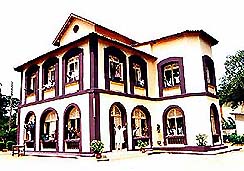 A head office in an ancient building wonderfully restored in Porto-Novo, capital of
Benin, with 500 m2 of offices and 1000 m2 of gardens. The restoration work, directly supervised
by the PREMA team, contributes to the development of one of the oldest parts of the town and to
re-create an attractive urban landscape.
A head office in an ancient building wonderfully restored in Porto-Novo, capital of
Benin, with 500 m2 of offices and 1000 m2 of gardens. The restoration work, directly supervised
by the PREMA team, contributes to the development of one of the oldest parts of the town and to
re-create an attractive urban landscape.
An international African team of eight people helped by a network of nearly 500 professionals in Africa and out.
An observatory which, using its library, identifies and gathers references, analyses practices and tendencies, and animates a network of varied professionals and publics interested in the African cultural heritage.
International activities such as:
training programmes, such as the PREMA university course, specialising in preventive conservation, consisting in a 1300 hour course, validated by the Maîtrise des Sciences et Techniques de Conservation et Restauration of the University of Paris1 Panthéon-Sorbonne,
AFRICA 2009, in collaboration with ICCROM and the World Heritage Centre, is a programme dealing with the preservation of immovable cultural property in sub-Saharan Africa, the aim of which is to include this heritage in a wider context of sustainable development.
the PREMA 2 course, currently under preparation, which aims at developing cultural heritage animation networks and programmes to encourage peace, tolerance and respect.
l'Académie des Fées to encourage and develop the creativity of African children.
workshops and seminars, around new challenges about cultural heritage.
Local activities which test projects destined to be diffused in sub-Saharan Africa such as:
the Jardin des Plantes et de la Nature of Porto-Novo (JPN). It consists of a laboratory carrying out ecological projects in order to enhance the quality of urban life by developing the awareness of town dwellers to the culture of nature,
the rehabilitation of the Palaces of Abomey museum, featuring on the World Heritage List, which aims at the preservation of the site while developing its educational powers and its self-financing capability,
special projects, such as the equipping of store rooms, cataloguing, computerisation of museum documentation systems...